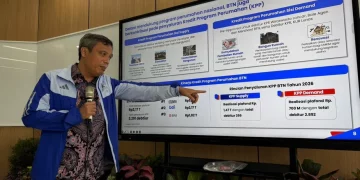

Jakarta – The Financial Services Authority (OJK) assesses that the stability of the financial services sector is maintained, amid the dynamics of global trade and political tension.
OJK Chairman of the Board of Commissioners Mahendra Siregar said, the dynamics of international trade showed progress after the trade agreement between the United States (US) and the UK on May 8, 2025 which was the first permanent US agreement with other countries after the postponement of the application of reciprocal tariffs.
“The temporary trade agreement between the US and China on May 12, 2025, which is valid for 90 days, has also reduced global trade tension,” Mahendra said at the RDK Press Conference, Monday, June 2, 2025.
Mahendra said market participants welcomed the agreement, which encouraged the strengthening of global financial markets, followed by a decrease in financial market volatility and capital inflow to developing countries.
“Geopolitical tensions have increased in a number of regions, however the impact can be localized so that the impact on global financial markets is still limited,” he added.
In addition, Mahendra said, global economic growth in the first quarter of 2025 weakened, followed by a continued decline in inflation, indicating weakening global demand. Thus, global monetary policy is increasingly accommodative, with several central banks lowering interest rates, injecting liquidity into the market, and even lowering reserve requirements. Meanwhile, global fiscal policy also tends to be expansionary, although fiscal space is limited.
“In the midst of these developments the Fed implies a Fed Fund Rate (FFR) policy high for longer, which is waiting for certainty from tariff policy and its impact on economic indicators,” he said.
Thus, this prompted the market to reduce the projection of FFR cuts to two times in 2025 from the previous three to four times. The first FFR cut is expected to be pushed back to September 2025.
Mahendra added, the market also continued to watch the issuance of President Donald Trump’s One Big Beautiful Bill which is expected to increase the US fiscal deficit, so Moody’s downgraded the US rating. This led to a weakening bond market and US dollar exchange rate.
Meanwhile, the domestic economy is still showing resilience amidst high global dynamics. Indonesia’s economic growth was positive in the first quarter of 2025 although it slowed to 4.87 percent, domestic demand, especially households, remained the main motor that grew 4.89 percent. Inflation is also maintained, recorded at 1.95 percent, still within the target range of Bank Indonesia (BI).
“The trade balance is also still in surplus, the current account deficit has narrowed to 0.05 percent of GDP from 0.87 percent previously, and foreign exchange reserves remain stable at a high level,” he concluded.
Furthermore, in the midst of slowing global economic growth, relatively high interest rates, and the ongoing process of US trade negotiations with several major trading partners, it is necessary to pay close attention to the impact on the performance of Indonesian debtors and the financial services sector.
Mahendra also requested that financial services institutions continue to conduct comprehensive assessments in order to be able to take the necessary mitigation steps in the future.
“On the other hand, OJK continues to perfect policies to deepen financial markets in synergy with ministries, institutions and related stakeholders in order to increase competitiveness and maintain the performance of the financial services sector for sustainable growth,” said Mahendra. (*)
Editor: Galih Pratama
OJK Boss Discloses Financial Services Sector Conditions Amid Trade War Tension
Jakarta – The Financial Services Authority (OJK) assesses that the stability of the financial services sector is maintained, amid the dynamics of global trade and political tension.
OJK Chairman of the Board of Commissioners Mahendra Siregar said, the dynamics of international trade showed progress after the trade agreement between the United States (US) and the UK on May 8, 2025 which was the first permanent US agreement with other countries after the postponement of the application of reciprocal tariffs.
“The temporary trade agreement between the US and China on May 12, 2025, which is valid for 90 days, has also reduced global trade tension,” Mahendra said at the RDK Press Conference, Monday, June 2, 2025.
Mahendra said market participants welcomed the agreement, which encouraged the strengthening of global financial markets, followed by a decrease in financial market volatility and capital inflow to developing countries.
“Geopolitical tensions have increased in a number of regions, however the impact can be localized so that the impact on global financial markets is still limited,” he added.
In addition, Mahendra said, global economic growth in the first quarter of 2025 weakened, followed by a continued decline in inflation, indicating weakening global demand. Thus, global monetary policy is increasingly accommodative, with several central banks lowering interest rates, injecting liquidity into the market, and even lowering reserve requirements. Meanwhile, global fiscal policy also tends to be expansionary, although fiscal space is limited.
“In the midst of these developments the Fed implies a Fed Fund Rate (FFR) policy high for longer, which is waiting for certainty from tariff policy and its impact on economic indicators,” he said.
Thus, this prompted the market to reduce the projection of FFR cuts to two times in 2025 from the previous three to four times. The first FFR cut is expected to be pushed back to September 2025.
Mahendra added, the market also continued to watch the issuance of President Donald Trump’s One Big Beautiful Bill which is expected to increase the US fiscal deficit, so Moody’s downgraded the US rating. This led to a weakening bond market and US dollar exchange rate.
Meanwhile, the domestic economy is still showing resilience amidst high global dynamics. Indonesia’s economic growth was positive in the first quarter of 2025 although it slowed to 4.87 percent, domestic demand, especially households, remained the main motor that grew 4.89 percent. Inflation is also maintained, recorded at 1.95 percent, still within the target range of Bank Indonesia (BI).
“The trade balance is also still in surplus, the current account deficit has narrowed to 0.05 percent of GDP from 0.87 percent previously, and foreign exchange reserves remain stable at a high level,” he concluded.
Furthermore, in the midst of slowing global economic growth, relatively high interest rates, and the ongoing process of US trade negotiations with several major trading partners, it is necessary to pay close attention to the impact on the performance of Indonesian debtors and the financial services sector.
Mahendra also requested that financial services institutions continue to conduct comprehensive assessments in order to be able to take the necessary mitigation steps in the future.
“On the other hand, OJK continues to perfect policies to deepen financial markets in synergy with ministries, institutions and related stakeholders in order to increase competitiveness and maintain the performance of the financial services sector for sustainable growth,” said Mahendra. (*)
Editor: Galih Pratama